Episode Transcript
INTRO: Welcome to the Trailblazers Podcast series by Periplum, sharing the experiences of trailblazers living and working in the Tees Valley: the innovators, activists, workers and adventurers as told in their own words.
Episode 13 Kirsten Luckins, Poet and Director of Tees Women Poets
Katherine [Interviewer]
Well. Good morning.
Kirsten [Interviewee]
Hello.
Katherine [Interviewer]
I'm in the town of Hartlepool on Teesside on the east coast and I'm talking today with Kirsten Luckins. Okay, so I'm going to start with an obvious question, which you must get asked all the time. Your name is pronounced Kirsten.
Kirsten [Interviewee]
Mm-hmm
Katherine [Interviewer]
But it's spelt Kirsten.
Kirsten [Interviewee]
It is.
Katherine [Interviewer]
What's the story there?
Kirsten [Interviewee]
The story there is that Kirsten, Kirsty, Shirsty, Keersten, Kyersten - it's a Scandinavian group of variants on Kirsten. And my father was travelling, I always thought in Norway, but recent conversations make me think perhaps it was Sweden, when my mum was pregnant. So his job involved a lot of international travel. He was a sales rep for a company here in Teesside that made hydraulic seals.
Can you imagine anything so exciting? As a child I thought it meant oh-oh-oh [makes sound of seal cries] seals, but it's not - in hydraulic seals. Anyway, he was in Scandinavia somewhere and my mum was pregnant and he kind of acquired this name as a souvenir, a sort of name that he liked, who was Kirsten and who was Keersten? Nobody knows, I haven’t dared ask.
Anyway, there was a Kirsten and he brought the name back and then part two of the story goes, I was meant to be Victoria Kirsten Luckins, so it was going to be tucked away like a little souvenir from Oslo or whatever. But then, the night that I was born, of all of the 6 or 7 girls born that night on my mum's ward, like 4 or 5 of them were called Victoria, and my mum decided that I was not going to have such a common name.
So they swapped it around. So I became Kirsten Victoria rather than Victoria Kirsten. That’s the myth.
Katherine [Interviewer]
That’s a not bad myth.
Kirsten [Interviewee]
That’s not a bad myth, is it?
Katherine [Interviewer]
So you've been in Hartlepool all of your life? Or…
Kirsten [Interviewee]
No, no, no, no. I was born in Sutton-in-Ashfield in Nottinghamshire, and we lived in Droitwich in the Midlands until I was three, moved to Yarm when I was three and a half, lived in Yarm until I was 16, went away to boarding school on a bursary when I was 17, 18. That was in York, came back for a bit, went traveling, went to university in London, went traveling, came back for a bit to London, lived on an
organic farm in Devon. Went back over to Europe, came back for a bit, ahh…moved to Newcastle. Stayed in Newcastle 12 years, then moved here 2010.
Katherine [Interviewer]
So quite peripatetic, life up to now…[laughs]
Kirsten [Interviewee]
Peripatetic. Yeah. Kind of a big, a big chunk of it in my 20s were free-wheeling
Katherine [Interviewer]
Exploring.
Kirsten [Interviewee]
Yeah.
Katherine [Interviewer]
What was the longest you stayed anywhere then, prior to Newcastle?
Kirsten [Interviewee]
So I was in London for my degree and then like a year or 18 months after my degree, and I didn't leave until - well my nan died and she left me some money and I kind of went, haha.
Money. Not very much money, but enough money to sort of catapult me out of what has become a little bit of a morass of not knowing what to do with myself in London. I gave away everything. I gave away all my books, and I gave away all my clothes. And yeah, I gave away almost everything, actually, almost. And got a ticket to India and went for what was meant to be six months, but turned into about two years.
And during that time, and about another six months or so, when I got back from India, where I was moving around the place, I had got a little bit - yeah, the freewheeling had accelerated somewhat. so I hadn't really spent more than a month anywhere for about maybe three years before I got back to Newcastle, where I gave myself the challenge of staying still for 12 months.
And I stayed for 12 years.
Katherine [Interviewer]
It's a challenge accepted and achieved.
Kirsten [Interviewee]
Ah hmm
Katherine [Interviewer]
Prior to that, you mentioned being in a bit of a, a London morass,
Kirsten [Interviewee]
[Sighs]
Katherine [Interviewer]
Not knowing your direction, a sense of casting off of that and making a significant choice to go to India. What made you pick India?
Kirsten [Interviewee]
I don't know that I had a very firm or rational reason for that.
I was sort of broadly attracted to my small and probably quite false understanding of what Indian culture [laughs] was or could be. I had an Indian boyfriend at university, I suppose, I thought it would be adventurous and romantic and exotic, and it seemed to be full of… places, the name of which were redolent with romance. You know, such a wordy child I was.
But like the idea of going to Varanasi, you know, just the words themselves. I went to Nepal as well, and just being in Kathmandu and that being an actual place [laughs]- the words, the romance, yeah, of course, it's all complete nonsense that I hadn't examined at all. But I did fall in love with India in a slightly toxic relationship kind of way. Like I had the first six months, and then I went to Nepal for a bit.
Then I ran out of money. So I swapped my ticket and went to Hong Kong. And I worked in Hong Kong for about 4 or 5 months. And then I went to Thailand and I thought I was going to keep doing the circuit. You know, I thought oh no I'll, I'll visit Thailand and visit some of those places. Maybe I'll get down towards, you know, across towards Indonesia or…
You know, maybe I'll make it to Japan. I regret not getting to Japan. Or Korea. You know, lots of people were coming that way and going towards India, but it felt like, but once you've been in India, nothing else will do. Even Nepal, even just stepping over the border where to all intents and purposes, nothing really has changed.
It's still not the same- there's something going on with India. There really is. It did feel a bit addictive, a bit grippy. So I went back to India. After Thailand, I was like, India’s not done with me, I have to go back. And I went back for another 6 or 7 months before it chewed me up and spat me out [laughs]
Katherine [Interviewer]
What do you think is the thing that's going on with India?
Kirsten [Interviewee]
Ah, I mean, at the time, I thought of it in terms of the extreme, like being drawn to something that was very extreme. India felt like it was a place of extremes: extreme wealth, extreme poverty, extreme heat, extreme injustice, extreme beauty, extreme ancient culture, extreme trash. It's just [laughs] like really, really all of the extremes. In actual fact, you know, you can apply that to really anywhere, simply where you've got a big division of rich and poor, but I don't know, it just felt very intense and it felt like magical thinking was a reasonable response to India, in a way that it doesn't particularly feel like
that to me in England, but in India, it's like, yeah, sure, I could just pick a tarot card and decide all of my life based on it. It really did feel like the magic was close to the surface in a wild magic kind of way, you know? Yeah, nothing else was as bright or as intense or meaningful. No where else did it.
Katherine [Interviewer]
There's a vibrancy that you're sort of reaching for in your words, I can see.
Kirsten [Interviewee]
I'm a poet where are the words, where are the words?
Katherine [Interviewer]
Was that our first experience, then, of a totally different culture?
Kirsten [Interviewee]
I mean, it was the most extreme experience of it. I travelled around Australia a little bit when I was like 18, and I stopped over in Singapore on the way out there, and even though I was only there for a couple of days, that was probably the biggest total break.
We arrived in a monsoon downpour and that was…just the force of the weather being that different, the force of the humidity being that different. It wasn't really any kind of experience or understanding of the culture being different, but just that feeling of being dropped into a completely different weather system [laughs] was interplanetary in its effect. But obviously Australia itself has got that glaze of white culture.
And as an 18 year old, I didn't penetrate that at all. With the exception perhaps, of being out in the Western Desert and under those unfamiliar stars and out in the red earth and just feeling how old it was just kind of glimmers of what it might be like to not be a teenaged idiot, but to be somebody who could understand better the truth of that land.
I got small glimpses of that. But no, you know, you can kind of skate along in Australia culturally, which I did. So yeah, well, I've been to Russia briefly and…which also has its own vibe. Right? Especially when I went at the end of the [19]90s. That was a vibe. But yeah, the extreme of India was the biggest jump I'd made.
And of course it's instant - you get off the plane. It's like everything louder than everything else. Like just, yeah, full volume from the first moment of getting there. It's kind of addictive. You know? This is why I keep thinking of it as being a bit like a toxic relationship, because it's like being love-bombed or bombed with something anyway. [laughs] Oh, yeah, I loved it.
Katherine [Interviewer]
Mm…I was struck when you said you went to Nepal and you came back to India, but after India you went to Hong Kong, which in my imagination is again a very different proposition.
Kirsten [Interviewee]
Yeah.
Katherine [Interviewer]
I'm picturing high rises, commerce. Busy, busy, busy, busy, busy….
Kirsten [Interviewee]
Very busy, very crowded. Busy in a different way from India. So yeah.
No, I went India, Nepal, Hong Kong, Thailand, India. So India was the bread of the sandwich. Hong Kong was the luncheon meat. Yeah. Hong Kong I hate it with every fibre of my being. Hong Kong was the most depressed I've ever been in my life. The most under pressure I've ever been in my life. There were a lot of people that I met in Hong Kong who were kind of testing themselves to breaking point, you know, it really did feel like it was a different kind of pressure, like India would chew you up and traumatize you, but like, like a nun smacking you around the head to try and get you to understand what the hell God was! India is like that. But Hong Kong just wants to kill you. It's horrific, I found it horrific. Everybody's so desperate. All the Westerners were pretty desperate to make money and get out. And maybe that's it. Maybe that was just the bubble that I was in. Was nobody really wanted to be there. They wanted to make money to get somewhere else.
And so I was staying in a hostel on the fourth floor of- not Chungking Mansions, which is the famous one, but the next tower block over in Tsim Sha Tsui. Tsim Sha Tsui TST. So there's two massive…there were two massive apartment blocks. Anybody who's been there will tell you that they do exist as cities, going upwards. There's none of this zoning that you get in places where you can sprawl out a bit, where you have eventually further up the peninsula or on different islands,
you have kind of housing estates or, you know, places, whether it's residential community versus shopping but, but at the bottom of TST, right down there is like- in our block, there were people living, there were also sweatshops, there were also casinos, there were also multiple hostels and hotels. You know, it's is completely crammed into this place. So going up and down the hallways and the stairwells at night was extraordinary, absolutely extraordinary.
But I hated it. And it was like 4 [people] to a room in like the size of a tiny little matchbox and everybody sleeping in shifts, because either you would have taken a day job or a night job. That's how it works in Hong Kong. When you're there for earning money,either you go down the, you know, Esole construction route-
So loads of blokes there doing construction, loads of people doing English lessons. So they all kind of go out and come back in. There's this switchover and then there's people like me who were doing night work- bouncers, barmaids and, like me, and karaoke hostesses. So my day was from kind of 3[pm] in the afternoon to 4[am] in the morning, kind of thing.
So I was almost completely nocturnal in Hong Kong, which also is horrible. And the job is horrible that I was doing. So one of the guys in my hostel invented a board game called ‘Escape from Hong Kong’, which was like snakes and ladders. You had to get from the starting points to Hong Kong Airport, which at the time I was there before they changed the airport.
So I had to come in to Hong Kong. You know, when it came down between the skyscrapers, like a metre clearance. I just liked the way [laughs] most terrifying thing I've ever done, maybe. No, not- but terrifying. So you had to get to Hong Kong Airport with a 100 Hong Kong dollar and 10 mental health points. And at any point on this journey, you could win or lose money on mental health points.
So if you fell on the square that said, become a karaoke hostess, you got five 500 HKD, but you lost all of your mental health points, like, you went into minus health points. It's just the worst, worst job. So yeah, I hated Hong Kong. So sorry. I wish I could have loved it, but I did not.
Katherine [Interviewer]
I'm getting a real sense with Hong Kong that there’s a life turned on its head or against nature kind of…
Kirsten [Interviewee]
Mm
Katherine [Interviewer]
way of living. We've gone from horizontal living to vertical living.
Kirsten [Interviewee]
Mm
Katherine [Interviewer]
We've gone from day living to night living. And where in India you were able to retain the sort of the natural thing and I'm still thinking of that 18 year old in the Western Desert in Australia as well?
Kirsten [Interviewee]
Hm. Yeah, yeah, definitely upside down. They don't even let you lie down on the grass in the park in TST. I, I used to try and go lie down in the trees, and there's a little man in the little uniform who comes along and goes ‘ning, ning,ning, neh’
And you're not allowed to do it. You have to sit on concrete. You can't even touch grass. I used to work with a load of women from the Philippines, and, you know, they would come over and they would be working this karaoke bar and making loads of money, obviously, sending it back to families, kids, etc. and they had a really beautiful congregation because they're all good Catholic girls, and they used to meet under the trees in the park and sing on a Sunday.
I don't know how the hell they got away with it…er…masses of them. It was really beautiful. But yeah, there's nothing like that for folk like myself. So yeah, it was unnatural - food unnatural, everything unnatural and proximity like the sense of personal space isn't the same. You know, the slightly…different places you go, people have different senses of personal space, born of necessity.
You know, there's a lot of people there. You can't be precious about where your boundaries start and finish when you have no choice. But when you first arrive there, and everybody else who lives there has grown up with it and is accustomed to it, everybody just gets up in your business all the time. It's kind of, yeah, anxiety inducing.
And then there's so much humidity in the air as well. It's like, the air is getting up in your business. [laughs] it’s sort of like aghh [makes a suffocating sound] there's no space!
Katherine [Interviewer]
It's interesting that that's come up really, because my next question was about your connection with landscape and environment.
Kirsten [Interviewee]
Yeah.
Katherine [Interviewer]
That I'm seeing now in your work as a poet and things that you are doing. How does your connection to landscape manifest for you?
Kirsten [Interviewee]
Yeah, I mean, obviously it has a big emotional and physical impact on me because here I am talking about stuff that is a million years ago, I was in Hong Kong before we gave it back to China. It's still British at that point. This is a long time ago and I can still feel in my body the impact of those different ways of living: different landscapes, urban landscapes, physical landscapes around me.
And then I, I feel like I've got almost kind of a dead gap for quite a long time after I came back from there, where I was just trying to reintegrate into English life. And I don't know, I think of myself in those years as being sort of like a tumbleweed, like a dandelion seed, not finding the place to be and kind of eventually rooting in Newcastle.
And at, at that point, I don't know that I was thinking about landscape as such or nature even as such. I think I was too far gone. But I did walk that city. I walked that place. And I love Newcastle because it is so walkable, and I felt like that physical act of traversing a territory of like assaying, there's a word for it, and I can't remember what it is because I'm old and my hormones won't allow me to think anymore.
But there's a word for where you establish a kind of cordon of how you can walk from a given point, like your home, and you go in all directions and you sort of understand your world and yourself, really, by testing the intersection of your physical limits and the landscape in which you find yourself, how far you can walk.
And that changes throughout your life depending on age and injury and all the rest of it. But it's, it's still a thing that you can do as a practice to orientate yourself within your environment, your landscape and yourself. And I did that a lot, a lot, a lot. And I partially was conscious of doing it in that sense.
And partially it was just an impulse, an unconscious impulse. And I believe that that's a really human impulse that loads of people have. I think it's kind of intrinsic to humanity and selfhood to sort of walk and touch and see and begin to establish relationships with the physical world. And as I've got older, more and more, what that has meant to me is engaging with the non-human world.
But I think I started doing it engaging with the human world. And at various points I've had various ways of filtering or organizing my perceptions and my experiences as I do this. I'm making it sound very highfalutin, it's not. This is just what people do anyway. But quite often I'll come back to a practice of…doing these kind of territorial walks and doing this kind of locating myself in a landscape, and I will be looking for…deliberately looking for moments of texture, detail, pattern, color.
You know, you can go out and you can just have a yellow day and say, I'm just going to be guided by wherever I see yellow. I'm going to go for that. And I started doing that in India because it was so overwhelming. The sense impressions were so overwhelming that I had to decide what I was going to look at, [laughs] because there's too much to look at!
So I would quite often go looking for kind of accidental geometry. So geometry as a shadow, and I take my camera in order to further frame to my perceptions. I think non-human landscapes and environments are becoming much more important to me now. Deliberately so, because with destroying it all…so it behooves us to maybe look at what it is that we're destroying before it's all gone.
And because I'm so ignorant, I can go out anywhere and go, I have no idea what that thing is that's been growing on my path for 14 years that I've seen all my life. I know nothing, I know nothing about anything. It's extraordinary. So that's the thing now for me is to go out, look and learn some stuff before it's gone.
Katherine [Interviewer]
So you’re sort of shifting there from experiential to knowledge in a more scientific way? Or an academic way?
Kirsten [Interviewee]
Yeah. I mean, it's decentering the eye a little bit. I mean, God! The years and years of being just about what I'm feeling is the glorious arrogance of youth, but I sort of extended it like a long way into middle age.
It's really boring. And this happened with the poetry, I’ve taken quite a long time to catch up or try to catch up, but with my poetry, I did what everybody does. You know, you start writing poetry because you want to talk about yourself, about a feeling that you're having or a thing that you're saying, or something that happened to you or what your mum was like or [laughs]
So all of those things, really valid things, really, really valid things, really important to think about them and express them. But after a while [makes sound] do you know what I mean? [laughs] I'm sorry, like to myself anyway, the people who can write about that and make a poem that is truly universal are incredibly skilled because it's a little bit like telling people your dreams, you know, does anybody care? I don't know.I don't know.
Anyway, so I wrote a lot of poems about how I was feeling, and bit by bit, I got really bored of myself, feeling bored of myself. And, to be fair, a lot of them got published. It's not like they were shit. It’s not like people maybe didn't get something from them. Some people did. Maybe. But I got so bored.
So over the last ten years or so, I've been trying to get just interested in anything other than myself, really. I'm very comfortable being very interested in myself and I started trying to write kind of historical poems or poems like verbatim poems, researching real people from history, writing about that. That's really good fun. But currently I think what I'm trying to bring in more of is writing about non-human trying to connect with that.
I'm not going to say that I've got very far with that yet. I don't know that I'm doing that particularly well. But it's a fascinating little corner of the poetry world and the thinking world and the ecological world is, is, I mean, I really I suppose ,the people who know about these things would dig into it down to kind of the philosophical thing about the knowable of the unknowable and, and…sentience and experiential differences between humans and cats, moths, whatever.
Again, I know nothing! I know nothing! But it's more interesting. It's more interesting to try and chase myself a little bit more in that direction.
Katherine [Interviewer]
Yeah. So when you first said distance from the eye, I can't remember your phrasing exactly...
Kirsten [Interviewee]
Yeah, yeah. De-centre, de-centre the eye
Katherine [Interviewer]
That’s it- decentering the eye. I was thinking of the visual line, which I'm getting a sense of, you see, and you feel very strongly that that decentering of the eye as a person.
I've found a phrase for this which is aesthetic distance, which I really like. But I'm also struck by these contrasts that are coming up and when we talked about India it was the extremes, extreme everything. And I'm seeing the internal eye Kirsten becoming the external Kirsten who’s realizing there is a bigger space. You've been to all these big spaces, different spaces, and you've absorbed them all.
They've left their imprint on you somehow. And, um, that change between- I’m existing in them to actually being part of them, and moving it beyond the world of people and your own world. We're here in Hartlepool.
Kirsten [Interviewee]
Mm
Katherine [Interviewer]
We’re on the coast.
Kirsten [Interviewee]
Mm
Katherine [Interviewer]
There are gulls going by. There is a big expanse of non-human out there. How does being in this environment coastal come to you?
How do you meet that on a daily basis?
Kirsten [Interviewee]
Well…we moved here in 2010 when I thought, at that point, that we would only stay maybe three
years or so. We inherited the house. Thank you Jim. And, um, I thought we'd do it up and flip it. I thought we'd do it up, have a lodger, make a bit, move on, maybe.
Cause I didn't really want to be in Hartlepool now. Hartlepool didn't have many good connotations in my mind. And if we hadn't have been right next to the beach, I don't know that we would have stayed quite so long. But the beach being this close to that expanse to the horizon, the openness of that has literally seen us through all bad times.
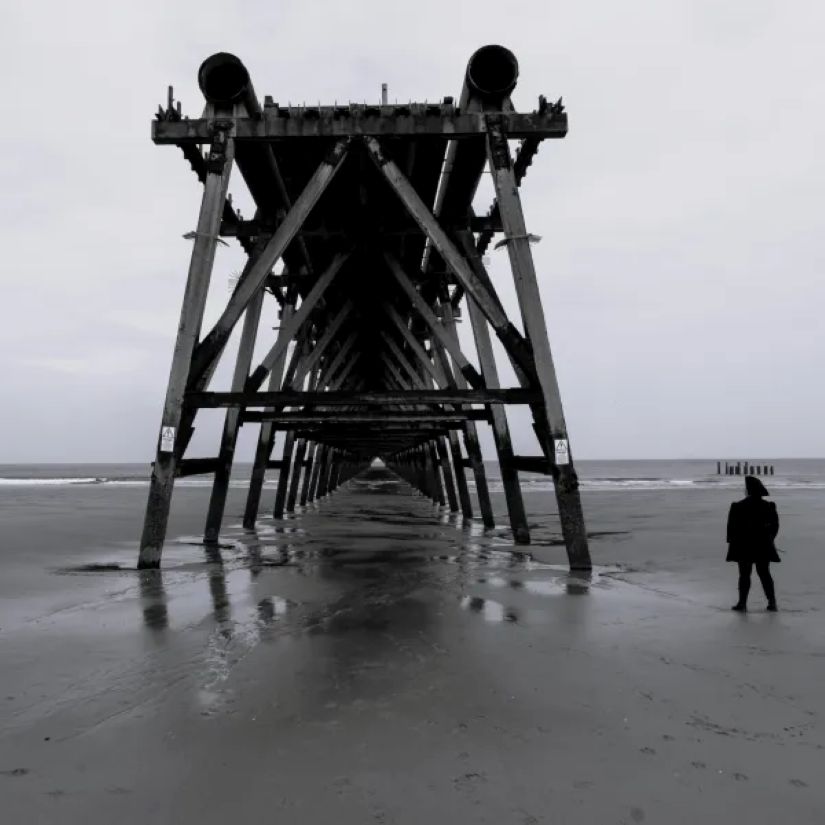
Pandemic obviously, but of the kind of ups and downs that are normal in a, in a life: you just take it to the beach, whatever it is, take it to the beach, walk it up the beach [growling sounds] chewing, chewing, chewing. Get to the pipeline or however far up you’re going- do a bit of Chi Gong - look at the horizon go: “Oh, right. Okay.”
Walk back without it. I think that's what people tend to do with nature. I think they tend to use it as a spiritual and emotional salve and dumping ground, almost as much as we use it literally, physically, as a dumping ground. We're very fast. We move too fast, do you know what I mean. It's got to be so much stiller and so much slower to actually feel truly part of the natural environment.
Even though of course, you are. But we're constantly moving through, so it's all there. I don't always fully meet it - too fast, we’re all too fast - but at least I can't ignore it because literally it's there. It's right outside the window. And now I don't know how people live not on the coast. How do you live not next to a huge body of water.
The sea. How is that possible? How do people live when there's no horizon but houses? I don't understand how they…[whispers] of course I do understand. I've done it. But do you know what I mean? So now I don't think I'm ever going to move away from here, other than, ofcourse, the predicted sea level rises is probably going to mean that we might have to live in the upper storeys like they do in Venice.
But yeah, everything has been taken to the beach and transformed there- transmuted, released, written in the sand, washed away. Sometimes I go down to draw a labyrinth. And I walk the labyrinth until it comes. Whatever the thought is.
Katherine [Interviewer]
You’re giving the sense of it, as your connection to the landscape is one that's been perhaps largely lost in our culture, in our society, but also one that is, it's there if we know how to connect with it.
And use it and it’s given you solace, and that word you use that sticks out for me is salve. It's a balm. It's something we rub on to soothe…
Kirsten [Interviewee]
Definitely.
Katherine [Interviewer]
…and calm. We've gone round the world with you, pretty much, today. We've come back to Teesside.
Kirsten [Interviewee]
Yes
Katherine [Interviewer]
And Hartlepool. Do you have a favorite Teesside place? Is there somewhere that lights you up in Teesside or around Tees,
Kirsten [Interviewee]
Ahh… lovely Teesside, Oh I couldn’t wait to get away from it when I was 18.
I mean I do love the beach outside the house and all the way up to Crimdon Dene. I love North Gare which is just the other side of Seaton Carew. I love walking around at low tide and there's always amazing driftwood. And then you come round and you can see all of the…[laughs] see the nuclear power station and all the petrochemical refineries.
And it's like being on Mars. It's amazing. I love the nature reserve at North Gare and, also, just further north from here it’s Spion Cop. They’re skylark nesting grounds, so I love the sounds that come from there, especially during pandemic. During the first lockdown, the, the noise of the skylarks was deafening. Absolutely deafening. You could hear it from the beach, all the way down from the top, it was, it was incredible.
So I like that. I like North Gare for the wildness and the windiness. Yes, I like the skies. I really came back for Teesside skies, you know, the openness of it. So wherever you can feel like you're really underneath the sky is good, you know, getting up the Nab or up the Topping and feeling the distances. That's good. I'm trying to get to know Coatham marsh a bit more.
And some of the other places from the Wildlife Trust, where I'm currently artist in residence, so I'm trying to get to know that a little bit more. And Poretrack Marshes as well, which is a bit of a hidden gem. I don't know, it's weird. Teesside. You always have to take a little bit of the rough with the smooth, you know, and I like that.
I like the edge-land feeling to the natural spaces here. Yeah. Saltholme I go to a lot. Greatham Creek. I do like this feelings of edge-land and reclamation. Salthome is so bizarre because it's all just filled in excavation sites and, you know, you drive down there and there’s gas release valves sticking up out of the mud. [laughs]
Yeah. It’s so Teesside.[laughs]
Katherine [Interviewer]
There's a real sense there. You know, we talked about the extremes just before that and then these edge-lands that are almost the balance point between the extremes…
Kirsten [Interviewee]
Yeah I do like the shifty-ness. There are pretty places certainly in south Teesside, but I'm never particularly drawn to anything that smacks of chocolate box. You know, I do like a bit of grime. [laughs]
Yeah. You know, I, I do have a childhood that it's full of late night joyrides with unsuitable boys down places that look like Bladerunner. You know, that's the joy of it. Yeah. That's what lights me up a little bit. [laughs]
Katherine [Interviewer]
You’re sort of beginning to circle back a little bit into…
Kirsten [Interviewee]
[laughs]
Katherine [Interviewer]
…the human world again, you know.
Kirsten [Interviewee]
Yeah…
Katherine [Interviewer]
We’ve taken that tour out of that compression of people, things in Hong Kong and back into finding your territories by walking out.
I know you're passionate about championing people and people with different lived experience, you know, particularly women, but in other fields as well, or other areas of life as well. What drives that? Where’s that come from? Do you think?
Kirsten [Interviewee]
I love to be able to say that, you know, I've felt deeply and wanted to be a champion the whole time,
But it's crept up on me much more. So the thing about kind of working with women and women poets came about cause I had, I had a job to work with poets full stop. And I was paid to do it. And I was given a lot of leeway to spend my budget on whatever I saw fit. And one of the things that I saw fit was around just everybody getting better at doing the poetry thing, like everybody getting better at performing.
I thought that would be a good thing to bring into the energy of the region - Let's just be good at stuff, you know, and get together and help each other be good at stuff. Not in a competition way, but in a…we're all amazing. Let's get together and be good at this and have fun. And one of the upshot of that was a group in Newcastle, which was a mixed group.
But when I tried to replicate it in Teesside, it didn't stick. And what stuck was making the group about women because the women asked for that- and so I was like, right, okay, that's the need, that's the need. I'll go with it. And then it became just increasingly a huge part of my life. And yeah, just a really valuable space for connection and…kicking my own feminism up it’s arse, because it was a bit lazy…
And, yeah, just trying to live the sisterhood shiz instead of talking about it. And that was just what I do. I've learned so much from the women I've worked with. I’ve learnt so much from all of the people I've worked with really- running the Tees Women Poets has been a driver for understanding so much more about myself and becoming myself and becoming a happier version of myself and
constantly trying to work out what praxis is for me. What do I have to do? What should I actually be doing with the work of my hands, with the work of my days? What should I be doing to live truthfully? To actually do what I think about and talk about, instead of being somebody who imagines my own life but never does it?
Does that make any sense?
Katherine [Interviewer]
It does. It makes a lot of sense.
Kirsten [Interviewee]
[laughs]
Katherine [Interviewer]
I mean, you know, there's something in that - looking for authenticity - in what your daily life involves - being you, being here in this time, in this place. What sort of challenges would you come up against with that?
Kirsten [Interviewee]
Oh my God, I mean, I'm…All the challenges. Err….never feeling like I have any financial security at all, even when I do.
Can't see it. Fully freelance. I was part time with a bit freelance. Now I'm fully freelance. Been fully freelance for five years. The world is ending. We are living under the jackboot of fascism. Women's rights are being eroded. I'm fucking terrified. There's no money left to do anything that I want to do. Everything's being diverted towards the efforts towards World War 3. Errr…yerlalala
All of that. That's current. That's currently what's in my head. But the slog of financial uncertainty, fear. However, that being said, I have been enormously privileged and lucky on so many levels - I'm able bodied, I'm neurotypical, I'm bright, I'm personable, I'm white. I am with a man who supports me completely. I have not endured multiple traumas.Err…
We inherited a house. Without this house, there's no way I could do what I do. Absolutely no way. I have met and been supported by so many incredible women. It's just astonishing. I speak the language of funders quite well. I can code switch. I know what the jargon is. So I can do that. Yeah, I've got lots and lots and lots of things going for me.
So…so in fact, there are challenges, but I am extremely well equipped to meet them. Thank you universe. That's very good.
Katherine [Interviewer]
That's part of that authentic living again that you, you know there are challenges, but you're also appreciative of what…you…
Kirsten [Interviewee]
Yeah
Katherine [Interviewer]
…you've got and how you've come to be here and are able to do what you do. We're coming to sort of wrapping up now.
And we selected you as a Teesside trailblazer. So I'm going to ask you who's been a significant trailblazer for you?
Kirsten [Interviewee]
So quite often when that kind of question comes up, like role models etc., etc., I find that my mind tends to skip often towards visual artists, often found like quite weird, though of course I do secretly harbour a desire to become a visual artist.
But anyway. So I always think about women who make art and don't seem to give a fuck. It's always that…like the, the one that is now a cliche, of course, is Frida Kahlo, and also nearly to the level of the cliche now Louise Bourgeois. Bourgeois I like, and feels like a trailblazer to me because of the longevity, because of the art into the 90s, because of the refusal to be contained by time or the idea of a career that is milestoned in terms of chronology.
I just love how she engages with the monstrous mother. I just love it. So that, but also Nicki de Saint Phalle- the idea that as an artist, you could just go, do you know what I really need to accomplish my vision is about 50 hectares [laughs] and a shitload of mosaic tiles [laughs] and I'm going to build things that you can live in.
I love it. So it's the refusal of limitations, I suppose, just literally blasting through them. Extreme refusal of limitation. It's not even like, oh, I'm going to be, you know, I'm going to be like Rothko, going to be like Pollock. I'm going to do huge canvases. You know, people are painting big before it's like[makes explosion sound] I mean, isn't that just absolutely magnificent?
I want to know more about land art as well. I'm trying to learn a little bit more about, about land art as a movement, because of course, that also is people going “I'm just going to dig a ditch that's 50 miles long, and I'm going to call it art” and it's like, yes! that sounds mint! Yeah, like I'm going to find a salt plane and build a 50 mile wide labyrinth in it. Yay!
Yeah. So, trailblazers that just don't recognize limits at all.
Katherine [Interviewer]
No constraints…
Kirsten [Interviewee]
No constraints. Other than the constraints that are imposed by your artistic vision, which is the same as what interests me with poems as well. Which sounds a bit counterintuitive because poems are very small on the page etc. I mean, they do have constraint, but what I'm interested in… is how you can make something out of whatever it might be, whether that's recycled paper or words from your brain, and make it in a shape and a form that is both beautiful and entirely functional as a vehicle for the meaning.
That is what interests me in poetry and in art. I'm not very good at it with art yet, but I can be quite good at it in words. I've been doing that longer. So anybody who really works those edges is inspirational to me.
Katherine [Interviewer]
Hmm…expanse, I'm getting expanse is coming through on a…
Kirsten [Interviewee]
Yeah.
Katherine [Interviewer]
On a scale…
Kirsten [Interviewee]
Big skies.
Katherine [Interviewer]
Big skies.
Kirsten [Interviewee]
Big canvases.
Katherine [Interviewer]
Big horizons.
Kirsten [Interviewee]
Yes
Katherine [Interviewer]
No clutter. So fast forwarding to when someone is listening back to this archive…
Kirsten [Interviewee]
Ohhh…Sorry.
Katherine [Interviewer]
The future generations - swearwords will be different by then.
Kirsten [Interviewee]
Nobody will ever get rid of fuck- fuck’s, fuck’s great. [laughs]
Katherine [Interviewer]
What are your hopes for future generations?
Kirsten [Interviewee]
Oh, just that there are any, for one. And that they're not, you know, horrifically oppressed and that there is something left of the environment. I mean to be honest with you, I don't feel very hopeful at the moment.
I think times are really bad and about to get worse. I feel like I might be living in a golden age of female emancipation, and that generations to come will look back on what we took for granted, and not believe that it was possible for women to live in this country with the freedom that they do. And I don't even know what to do with that thought.
So I really hope that I'm wrong on that. I really hope that, that we don't go backwards and that future generations have some reason to be grateful to my generation, to our generation now, because we’re really…some of us, some people are trying very hard, but on the face of it, we are fucking them over royally. We're not being good ancestors at all.
Yeah
Katherine [Interviewer]
So if you could speak to those future generations directly, this is your opportunity to tell them ...something directly. What would you say?
Kirsten [Interviewee]
We’re so tired…we’re trying and we’re trying and we’re trying and and we’re trying. And the wrong people have all the money. And we’re so scared and we’re so tired and it’s so difficult to even find one clean, purposeful, meaningful, effective thing to do.
Every part of life is in the middle. We just rip each other apart. We argue and we don't even argue face to face, so we can't reconcile. It's just hate versus hate versus - tell you what, I'll just look at cat videos for two hours because that's easier.
Er…[sighs] Fuck knows what is happening between men and women. It's horrific. And also, I don't even know if it's as bad as I think it is because we are being swallowed alive by our own social media and one of the impacts of that is that everything seems simultaneously worse than it is, and more trivial than it is.
It's a weird paradox, and it is literally eating our brains. Yeah. If it goes as bad [laughs] as, like nightmares tell me it will. There's nothing to say but sorry really. And if it goes better. And if, if, if it goes better, then well done you. Cause I don't know that it would be us that makes it get better.
OUTRO: Thank you for listening to Periplum’s Trailblazers Podcasts funded by the National Lottery Heritage Fund. To listen to more of the series, and follow our projects visit our website at periplumheritage.com